
Vaper’s Cough and Vaper’s Tongue: Causes and Quick Fixes
2nd Aug 2017
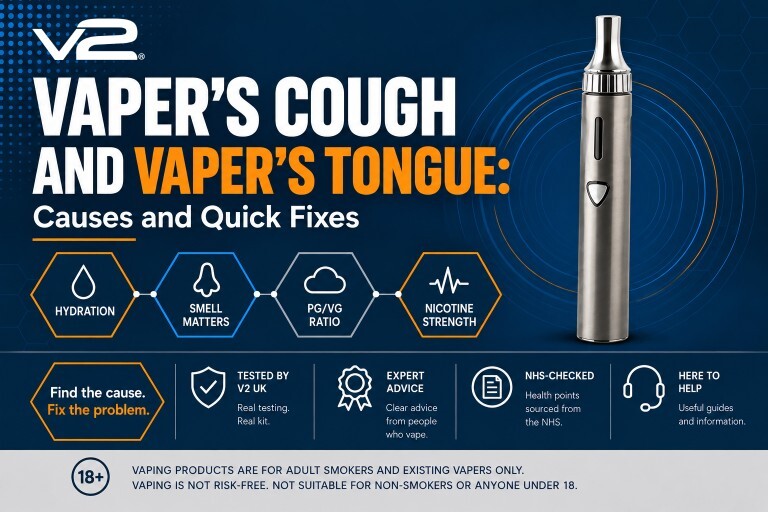
Vaper's tongue is a sudden loss of flavour or a numb feeling on the tongue, and vaper's cough is a dry, tickly cough that shows up in the first few days of vaping. Both are common, both are usually gone within a few days to a couple of weeks, and both have a handful of well-known causes you can work through one at a time.
This guide also covers extra phlegm after switching from smoking, why you might taste e-liquid in your throat or on your lips, and when NHS guidance says a cough is worth getting checked.
By Joe Delaney; Director and Content Writer, V2 Cigs UK.
Originally Published: 2nd August 2017.
Last updated: 15th October 2026.
Vaping products are for adult smokers and existing vapers only. Vaping is not risk-free. Not suitable for non-smokers or anyone under 18.
Vaper's Tongue: Why Your E-Liquid Suddenly Tastes of Nothing
Your all-day flavour has gone flat, or your tongue feels a little numb no matter what you vape. That's vaper's tongue, sometimes called vaper's fatigue, and it isn't a sign anything is wrong with your device.
Vaping the same flavour for too long is the single biggest cause. Your palate gets used to a flavour the same way your nose stops noticing a smell you're around all day, and the taste fades even though the e-liquid hasn't changed.
Dehydration plays a bigger role than most people expect. The bases in e-liquid, propylene glycol (PG) and vegetable glycerine (VG), both draw moisture out of your mouth as you vape, and PG in particular is hygroscopic, meaning it actively bonds with the water in your saliva. NHS guidance on hydration recommends aiming for 6 to 8 cups or glasses of fluid a day, and topping that up matters more when you're vaping regularly.
Recently switched from smoking? NHS Better Health says your senses of taste and smell start improving within 48 hours of stopping smoking, so flavour can seem different for a while as your palate adjusts. This tends to settle the longer you stay smokefree.
Illness plays a part too. A cold, blocked sinuses, or a sore throat can all mute flavour the same way they mute the taste of food, and it's not specific to vaping. If a sore throat is the main issue rather than a lost sense of taste, our guide to why your throat feels sore after vaping covers that separately. Poor oral hygiene can affect flavour too, so a solid brushing routine is worth ruling out alongside everything else, per NHS advice on gum disease.
Old or expired e-liquid loses flavour intensity over time, so if a bottle's been open a while, that's worth checking before you assume the problem is you.
Why Smell Plays Such a Bigger Role Than You'd Think
Most of what you taste is actually smell rather than your tongue doing the work. NHS ENT guidance puts it at 60 to 70% of flavour perception, which is why a blocked nose from a cold flattens your vape the same way it flattens a meal. Short-lived changes like this are common: smell disorders as a whole affect around 5% of people at any given time, and most cases clear up on their own.
Doctors have specific terms for longer-lasting changes, in case you come across them: a reduced sense of smell is hyposmia, a complete loss is anosmia, smells seeming different than they should is parosmia, and smelling something that isn't there is phantosmia. None of these are caused by vaping itself, but they're worth knowing if a change in taste or smell sticks around rather than settling within a couple of weeks.
How to Fix Vaper's Tongue
Switch flavours for a few days. Don't swap for something similar, pick a completely different profile. A couple of days on something else is usually enough to reset your palate before you go back to your usual Platinum e-liquid flavour. If you're switching flavours often, clean your tank out properly first, or the last flavour will linger and muddy the new one.
Hydrate properly, not just when you remember. Little and often works better than one large glass. If you're chain-vaping through the day, your fluid intake needs to keep pace.
Give it time if you've recently quit smoking. Your sense of taste takes a little time to settle, and pushing through a flat period is common for people who've recently managed a smoking relapse or are newly smokefree.
Try a palate reset. Smelling fresh coffee beans or something citrus between flavours is a trick borrowed from wine and perfume tasters, and plenty of vapers find it works for e-liquid too.
If your sense of taste or smell stays affected for more than a couple of weeks, it's worth getting it checked rather than assuming it's vaping-related. NHS guidance on changes to your sense of smell confirms this is usually not serious and often clears up on its own, but it's still worth ruling out other causes if it persists.
Why Can I Taste Vape Juice in My Throat or on My Lips?
Tasting the e-liquid itself, rather than the vapour, isn't vaper's tongue. It means small amounts of liquid are reaching your mouth, and the cause is nearly always the device. These are the usual culprits:
- Spitback from a flooded coil. Too much e-liquid in the coil, often from long, hard pulls, gets spat up the mouthpiece as tiny hot droplets. You'll usually hear crackling or gurgling, and it can catch the back of your throat, sting your tongue or make you cough. Our guide to why your vape is bubbling, popping, spitting or gurgling covers the fixes.
- A leak. A worn seal, a cracked tank or a loose coil lets liquid collect around the mouthpiece and on your lips. Follow our steps to fix a leaking vape.
- Overfilling or condensation. An overfilled tank or pod, or condensation building up in the drip tip, leaves liquid sitting where your mouth goes. Fill to the line and wipe the mouthpiece regularly.
- A metallic or burnt taste. That usually points to the coil: a new one that wasn't primed or an old one that's worn out. See why your vape tastes burnt.
If you get e-liquid in your mouth, rinse with water and don't swallow it, and keep nicotine e-liquid out of reach of children and pets.
What Is Vaper’s Cough? The Tickly Cough New Vapers Get
That prickly cough at the back of your throat after a few puffs is vaper's cough, and it's most common in the first few days after switching to vaping. It comes up often enough on our Customer Service team calls, emails and LiveChat contacts that it's one of the first things we check for when someone writes in saying their new kit makes them cough. It isn't the same sensation as cigarette smoke, and for most people it settles down on its own within a matter of days.
If your cough has more to do with how you vape than with being new to it, our guide Why Does Vaping Make Me Cough? goes into more detail.
What Actually Stops Vaper's Cough?
Check your PG/VG ratio. A 100% PG e-liquid is more likely to trigger a cough than a blended or higher-VG option, since VG is smoother on the throat. If you've been vaping straight PG, this is usually the first thing worth changing.
Reduce your nicotine strength slightly. Too high a nicotine level for your habits can trigger coughing on its own. Our nicotine strength guide walks through how to work out the right level for you, rather than guessing.
Try a different inhalation style. Mouth-to-lung and direct-to-lung feel very different in the throat, and switching between them can settle a cough that one particular style is triggering. Our how to vape guide covers both techniques if you're not sure which you're currently using.
A cough that's stuck around for more than three weeks is generally worth getting checked regardless of the cause. NHS guidance on coughs treats three weeks or more as a persistent cough worth a GP visit, and that applies whether or not vaping is part of the picture.
Can Vaping Cause Phlegm?
Some people notice they're coughing up more phlegm in the first few weeks after switching from smoking to vaping, and it's one of the questions our Customer Service team hears most from new switchers. NHS Better Health's quit smoking timeline says that 48 hours after you stop smoking, your lungs are clearing out mucus, and the NHS lists smoking as a common cause of coughs. So a cough you had as a smoker may not clear the moment you switch.
A blog post can't tell you what's behind your own cough, but these vape-side checks are worth making:
- Drink enough fluid. PG and VG both draw moisture from your mouth and throat, so keep your fluid intake up through the day.
- Check your e-liquid. A high-PG e-liquid or a nicotine strength that's too high for you can irritate your throat. The fixes are the same as for vaper's cough above.
- A sweet taste at the back of your throat usually comes from the e-liquid itself, since VG is naturally sweet and most e-liquids contain sweet flavourings.
If phlegm sticks around, or comes with any of the signs in the next section, get it checked rather than putting it down to vaping.
Is It the Vape or Something Else?
Most of what people notice when they start vaping is minor and fixable at home. NHS guidance on vaping to quit smoking lists a dry mouth and throat, and mouth and throat irritation, among the common side effects.
Usually down to the vape:
- a dry mouth or throat
- flavour fading or tasting of nothing (vaper's tongue)
- a tickly cough in the first few days
- tasting e-liquid in your throat or on your lips
- a harsh hit from nicotine that's too strong or a high-PG e-liquid
Get checked, whatever the cause:
- a cough that's lasted more than 3 weeks
- losing weight for no reason
- a change in taste or smell that doesn't settle within a couple of weeks
The NHS says to ask for an urgent GP appointment or get help from NHS 111 if you're coughing up blood, have chest pain or find it hard to breathe.
Frequently Asked Questions
How long does vaper's tongue usually last?
Most cases clear up within a few days, though it can take up to two weeks if the cause isn't addressed. Switching flavours and staying hydrated are usually enough to speed it along.
Is vaper's cough a sign something's wrong with my device?
Not usually. It's far more often down to PG ratio, nicotine strength, or simply adjusting to vaping for the first time, rather than a fault with the kit itself.
Can I prevent vaper's tongue from happening again?
Rotating between two or three flavours rather than vaping the same one constantly is the most reliable way to avoid it recurring, alongside staying hydrated.
Should I stop vaping if I get vaper's cough?
There's no need to stop for a mild, short-lived cough while you adjust. If it persists beyond a few weeks or comes with other symptoms, that's the point to get it checked rather than push through.
What is vaper's cough?
Vaper's cough is a dry, tickly cough at the back of the throat that some people get in the first few days of vaping. It's usually down to a high-PG e-liquid, a nicotine strength that's too high, or a vaping style that doesn't suit you, and it normally settles within days.
Does vaping cause phlegm?
Some people notice more phlegm after switching from smoking, and the NHS lists smoking as a common cause of coughs. Staying hydrated and checking your PG/VG ratio and nicotine strength are worth trying, and NHS guidance is to see a GP if a cough lasts more than 3 weeks.
Why can I taste vape juice in my throat?
Usually because droplets of e-liquid are reaching your mouth, from a flooded coil spitting back, a leak or condensation in the mouthpiece. Gentler puffs, a dry mouthpiece and a fresh, primed coil normally fix it.
Is it normal to taste vape juice on my lips?
It's common, and it usually means liquid is collecting on the mouthpiece from a leak, an overfilled tank or condensation. Wipe the mouthpiece, check the seals and coil, and rinse your mouth with water if you get e-liquid in it.
What does vaping taste like, and can you taste nicotine?
Mostly it tastes of the e-liquid flavour you choose. Nicotine itself adds a slightly peppery catch at the back of the throat, known as throat hit, which is stronger at higher strengths and with freebase nicotine than with nicotine salts.
Useful Guides Related to This Topic
- Why Does Vaping Make Me Cough?
- Sore Throat From Vaping? 8 Causes and How to Fix Them
- Why Does My Vape Taste Burnt? 8 Causes and Quick Fixes
- Why Is My Vape Bubbling, Popping, Spitting or Gurgling?
- How to Clean a Vape Tank and Coil: Step-by-Step Guide
- Vape Nicotine Strength Calculator: What Strength Do I Need?
About the Author
 Joe Delaney looks after the day to day running of V2 Cigs UK and writes its blogs.
When the blog recommends a device, he has used it - and for a leak test that means actually filling kits and trying to make them fail, pocket-carrying them and leaving them upside down overnight, rather than repeating manufacturer claims.
Health, safety and regulatory points are checked against named UK authorities such as the NHS and MHRA, and a product is only ever called "less harmful than smoking" where a UK authority says so. More about how he works, and the family story behind V2, is on Joe's author profile.
Sources
- NHS Guidance on Hydration
- NHS Gum Disease and Oral Hygiene - NHS Advice on Gum Disease and Oral Hygiene
- NHS (University Hospitals Birmingham Foundation Trust) - Smell and Taste Science
- NHS - When to See a GP for Smell/Taste Changes
- NHS - When to See a GP for a Persistent Cough
- Questions and answers sourced from the V2 UK customer service and logistics teams
- NHS Better Health: Quit Smoking (what happens when you stop)
- NHS Better Health: Vaping to Quit Smoking
Vaping products are for adult smokers and existing vapers only. Vaping is not risk-free. Not suitable for non-smokers or anyone under 18.
Last updated: 15th October 2026.