
18650 vs 21700: The Complete Vape Battery Guide
21st Feb 2025
By Joe Delaney; Director and Content Writer, V2 Cigs UK
Originally Published: 21st February 2025.
Last updated: 8th September 2026.
Vaping products are for adult smokers and existing vapers only. Vaping is not risk-free. Not suitable for non-smokers or anyone under 18.
18650 vs 21700: The Complete Vape Battery Guide
Your battery affects your vape more than almost any other component, from how long it lasts between charges to how safely it performs. This guide covers what the numbers on external batteries like 18650 and 21700 actually mean, automatic versus manual batteries on our own devices, how to charge safely, and how to look after a battery properly.
What Do the Numbers on a Vape Battery Mean?
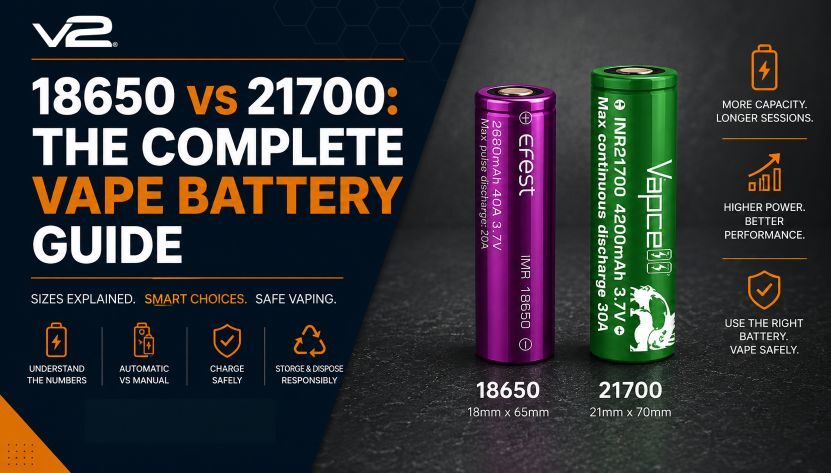
Battery names like 18650 and 21700 describe the cell's physical dimensions, not its capacity or safety rating. The first two digits are the diameter in millimetres, and the last three digits are the height in tenths of a millimetre. So an 18650 battery is 18mm across and 65mm tall, and a 21700 is 21mm across and 70mm tall. The extra size on a 21700 isn't just for show: more physical space generally means more capacity and a higher safe power output.
These aren't interchangeable. A 21700 is too large to fit a device designed around 18650 cells, and forcing one in isn't something to attempt. Always check what your specific device is rated for before buying a replacement battery.
Automatic or Manual: Which Battery Type Do You Need?
If you're using one of our own V2 or Vsavi devices, the choice between automatic and manual batteries matters as much as the external-battery decision below.
Automatic batteries fire simply by inhaling, which is why most new vapers start with one; it mimics the experience of a cigarette closely and needs no button to learn. Manual batteries require you to press and hold a button while you draw, giving you more control over exactly when the device fires, and they tend to last longer between charges as a result, since there's no risk of the battery firing accidentally in a bag or pocket. Neither is objectively better. If you want the simplest possible experience, particularly if you've recently switched from smoking, automatic is the natural choice. If you'd rather have direct control and don't mind the extra step, manual suits you better.
18650 vs 21700: Which External Battery Should You Choose?
If your device takes external batteries rather than a built-in one, the choice usually comes down to these two.
18650 is the longer-established, more widely available option. It typically ranges from around 1500mAh up to roughly 3500mAh depending on the model, is compatible with a broader range of devices, and is generally cheaper and quicker to charge than a 21700. It's a solid choice for most single or dual-battery mods and remains the most common external battery format in vaping.
21700 is the larger, newer format, typically running from around 2500mAh up to 5000mAh. That extra capacity means longer sessions between charges and supports higher wattage output, which makes it the natural choice for sub-ohm vapers and cloud chasers running higher-power setups. The trade-off is a bigger, heavier battery that won't fit every device.
Neither is universally “better.” An 18650 suits lighter use, portability and broader compatibility; a 21700 suits heavier, higher-wattage use where the extra size is worth it for the extra capacity. Always check what your specific device is designed for before buying either.
Charging Your Vape Battery Safely
Good charging habits protect both your battery's lifespan and your safety.
- Use your battery regularly. Batteries are designed for frequent use, and leaving one unused for long periods makes it less efficient over time.
- Keep your battery at room temperature when charging and storing it, ideally between 20°C and 25°C. Heat is particularly damaging to lithium-ion cells.
- Never let your battery run completely flat before recharging. A full discharge puts more strain on the cell and shortens its usable life. Charge it when you notice performance starting to dip rather than waiting for it to die.
- Unplug your battery as soon as it's finished charging. Leaving it on the charger overnight, every night, causes unnecessary wear over time.
- Disconnect the tank or cartomizer from the battery if you won't be using your device for a while. Even sitting connected causes a small, constant drain.
- If you're storing a battery for an extended period, don't store it fully charged or fully flat. Around 40% charge is generally recommended for longer-term storage.
- Always use a charger designed for your specific battery type, and never leave a battery charging unattended.
- Invest in a decent charger and decent batteries from a reputable brand. Cut-price cells are far more likely to cause problems down the line.
Vape Battery Safety
Lithium-ion batteries are used safely in millions of devices worldwide, from laptops to power tools, and vape batteries are no exception when they're used and cared for properly.
Electrical Safety First, the UK charity focused specifically on reducing electrical injuries and deaths, names damaged batteries, incorrect chargers and overcharging among the main causes of lithium-ion battery failure - genuine safety incidents are rare, and almost always trace back to one of these, or to batteries carried loose alongside metal objects.
- Store spare batteries in a proper case or protective sleeve, never loose in a pocket or bag with keys or coins.
- Never leave a battery in a hot car or anywhere it's exposed to direct heat.
- Don't overtighten a tank or atomizer onto the battery when fitting it.
- Charge on a hard, fireproof surface, not on a bed, sofa or other soft furnishing.
- Check batteries regularly for swelling, corrosion or other visible damage, and stop using one immediately if you spot any.
- If a battery ever overheats, hisses or bulges, don't use it. Move it away from anything flammable straight away.
- Never modify a battery, charger or device beyond how the manufacturer intended it to be used.
- Only use e-liquids and cartridges that are actually compatible with your device.
Disposing of an Old Vape Battery
Lithium-ion batteries fall under UK WEEE regulations, which means they shouldn't go in general household waste; you'll usually see a crossed-out bin symbol on the packaging as a reminder. Take old or damaged batteries to a proper recycling point instead. Most large supermarkets and electronics retailers have collection points, and Recycle Your Electricals' postcode locator covers around 30,000 UK drop-off points if you're not sure where your nearest one is.
Frequently Asked Questions
Can I use an 18650 battery in a device designed for 21700?
Not directly. Some devices include a manufacturer-supplied adaptor sleeve that allows an 18650 to fit a 21700-sized compartment, but never improvise your own adaptor or force a battery to fit.
How many times can I recharge a vape battery?
Most external batteries handle at least 300 to 500 full charge cycles, and higher-quality cells can last significantly longer. Performance gradually declines with age and use, which is normal.
Is it safe to leave my battery charging overnight?
It's best avoided. Charging on a fireproof surface while you're able to keep an eye on it, rather than leaving it plugged in unattended overnight, is the safer habit, and unplugging as soon as it's full helps protect the battery's long-term performance too.
Should I choose automatic or manual for my first device?
If you've just switched from smoking, automatic is usually the easier starting point, since it needs no button and feels closest to a cigarette. You can always try manual later if you want more control.
About the Author
 Joe Delaney looks after the day to day running of V2 Cigs UK and writes its blogs.
When the blog recommends a device, he has used it - and for a leak test that means actually filling kits and trying to make them fail, pocket-carrying them and leaving them upside down overnight, rather than repeating manufacturer claims.
Health, safety and regulatory points are checked against named UK authorities such as the NHS and MHRA, and a product is only ever called "less harmful than smoking" where a UK authority says so. More about how he works, and the family story behind V2, is on Joe's author profile.
Useful Links Related to this Topic
- Why Does My Vape Taste Burnt?
- Vaper's Tongue and Vaper's Cough: What They Are and How to Fix Them
- Selecting Your Vape Coil: A Complete Guide
- How to Clean and Maintain Your Vape
- Why Is My Vape Spitting, Popping or Gurgling?
- Common Vaping Questions - The FAQ Hub
Sources
- GOV.UK - WEEE Regulations on Waste Electrical and Electronic Equipment
- Recycle Your Electricals Org - Postcode Locator
- Electrial Saftey First - Lithium Ion Battery Safety Guidance
Vaping products are for adult smokers and existing vapers only. Vaping is not risk-free. Not suitable for non-smokers or anyone under 18.
Last updated: 8th September 2026.