
The £2.20 Vape Tax: Inside the Industry's Case Against the Rate
10th Sep 2026
By Joe Delaney; Director and Content Writer, V2 Cigs UK
Originally Published: 10th September 2026.
Last updated: 10th September 2026.
Vaping products are for adult smokers and existing vapers only. Vaping is not risk-free. Not suitable for non-smokers or anyone under 18.
The Vape Tax: Inside the Industry's Case Against the Rate
Ten weeks before the UK's new Vaping Products Duty takes effect, HMRC sent its own policy lead into a room full of the people it will affect most.
At the UKVIA Industry Forum, held at the National Liberal Club on Whitehall Place on 13 July, a short walk from the Treasury that set the rate, HMRC's Jacob Holder took questions from an industry armed with a Freedom of Information investigation into the number behind the tax. UKVIA, the trade body representing the UK vaping industry, hosted the event.
What follows is what was actually said, by whom, on the day.
A Retailer's Hunch, and an FOI Request
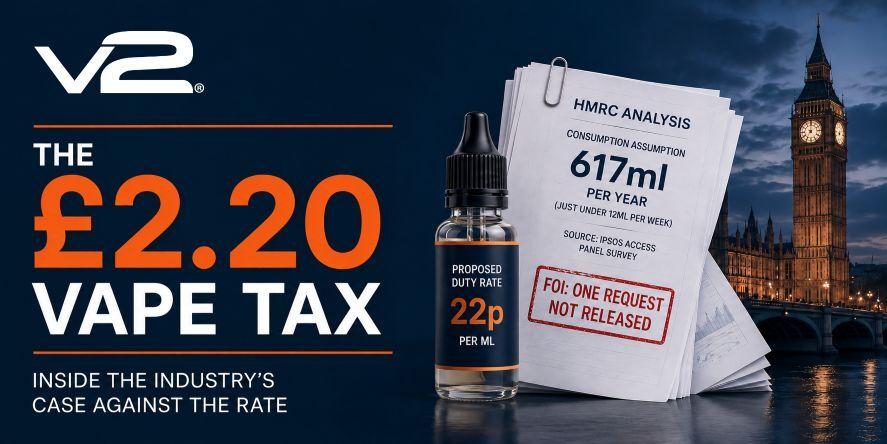
The case against the rate started with Dan Marchant, co-owner of Vape Club, and a feeling that the government's figures didn't match what he saw in his own shops. Rather than leave it there, he filed three Freedom of Information requests with HMRC: what average e-liquid consumption figure had been used to set the duty, where it came from, and whether the underlying analysis could be released.
HMRC answered the first two and withheld the third.
The figure was 617ml a year, just under 12ml a week. The source was a survey run by the market research firm Ipsos, using an access panel: a pool of pre-vetted respondents paid in vouchers to take part. Marchant had previously worked at Ipsos himself, and recognised a specific gap when he looked at the methodology.
Access panels are prone to people claiming an interest they don't have in order to collect the incentive, and the standard defence is a screening question only a genuine member of the group could answer correctly. This particular survey didn't have one.
What Real Vapers Actually Use
To test the figure independently, UKVIA ran its own survey through verified member customer lists rather than an access panel, with no incentive offered. Presented at the Forum by Tim Phillips of Tamarind Intelligence, the 3,500-response survey put average consumption at 26ml a week, more than double the Ipsos-derived figure.
An economic assessment from the Centre for Economics and Business Research (Cebr) then weighted that down against separate ASH data, landing at 22.5ml a week. Still, on either number, roughly double what the duty rate assumes.
What the Modelling Says
Marchant's presentation walked delegates through Cebr's modelling at the proposed 22p-per-ml rate: a net increase of more than 700,000 smokers, made up of over 300,000 new pure smokers and 400,000 dual users lost from a path to quitting, alongside an additional 1.5 billion cigarettes sold annually, a projected loss of 958,000 vapers, and a net cost to the economy of more than £300 million a year in healthcare and lost productivity.
Modelled at 11p per ml instead, Marchant said, that economic cost falls to £30.2 million, a reduction of more than 90%. At 8p per ml, the model flips to a net benefit of £45.5 million.
His closing point to the room was that he isn't seeking to stop the duty, only to have HMRC revisit the figure it's built on.
What HMRC Conceded, and What It Wouldn't Say
Responding to member questions in a dedicated session, Holder gave ground on one point and held firm on another. He confirmed the transitional duty stamp arrangement has been extended to the end of the 2026 calendar year, for businesses whose systems aren't ready in time, while stating plainly there are "no plans for an extension beyond the 1st of October" for the duty itself.
HMRC has recruited 300 new compliance officers and committed £10 million to Border Force activity, with penalties running up to £10,000 and custodial sentences possible for the most serious cases.
What Holder wouldn't do was name the metrics HMRC will use to judge whether the duty has worked, telling the room he didn't want to hand anyone a reason to argue for a two-year delay. He also declined to publish the internal analysis behind the original rate when Marchant asked for it under FOI, the one request of three that went unanswered.
UKVIA's own team thanked HMRC publicly for the level of engagement, saying it hoped other government departments would follow the same approach.
The Wider Mood in the Room
Health psychologist Sairah Salim-Sartoni, speaking on the same panel as Marchant, put a sharper edge on the consumer data: only around 13% of vapers said they'd carry on as normal at the proposed rate, with the rest splitting between the black market and a return to cigarettes.
Leonhard Kipphan of osapiens, the Forum's compliance-focused headline sponsor, set out the practical squeeze: the track-and-trace regime behind the duty stamps has to be fully operational by April 2027, against tobacco duty's five-year run-in before enforcement tightened to a similar degree.
Chris Kelly, founder of distributor Phoenix 2 Retail, made a related point about the industry's other looming change, retail licensing: the design matters more than the scope, and the risk is a scheme that becomes a barrier to legitimate retailers rather than a filter against illegitimate ones.
Opening the day, UKVIA director-general John Dunne had set the stakes plainly: push legal prices up while illicit alternatives stay cheap, and some consumers go to the black market while others go back to smoking. Neither, he said, is good tax policy, good regulation, or good public health.
Two Nicotine Products, Two Tax Regimes
Salim-Sartoni's second argument concerned how the duty sits against the tax treatment of other nicotine products. Nicotine replacement therapy (patches, gums and lozenges) is licensed as medicine by the MHRA and taxed accordingly: 5% VAT over the counter, nothing at all on prescription.
Vaping products are not licensed medicines; they're regulated as consumer goods, and from October they'll carry 22p per millilitre in duty on top of the standard 20% VAT. Two categories of nicotine-containing product, two entirely different regimes.
The gap comes down to how each reached the market. NRT went through MHRA medicines authorisation, which requires clinical data, efficacy evidence and ongoing safety monitoring.
The reduced VAT rate follows from that licensed status. Vaping products arrived by a different route, notified as consumer products under the Tobacco and Related Products Regulations. Duty widens the gap further, because it's a different instrument altogether: the Vaping Products Duty is an excise duty, of the same family as alcohol and tobacco duty, levied on consumer goods.
Licensed medicines attract no excise at all. The two categories aren't taxed differently within one system; they sit in different systems.
What makes that harder to write off as an accident of history is that the medicines route isn't closed to vaping, it has largely gone unused. One e-cigarette, British American Tobacco's e-Voke, was granted a UK medicines licence in late 2015, and its development was terminated before it reached the market.
In October 2021 the MHRA rewrote its guidance specifically to make that route easier, a move the government described at the time as a world first. By April 2022 it had received no applications. As of February 2025, NICE records that no nicotine-containing e-cigarette is both licensed as a medicine and commercially available in the UK.
Part of the reason is structural: a medicines licence applies per product, which makes the route impractical for a category running to hundreds of flavour and strength combinations. Salim-Sartoni's point to the room was that whatever the regulatory logic, the tax categories don't reflect how the products are actually being used.
Andrej Kuttruf, founder and chief executive of Modern Health Group, went further, calling the regulatory framing pretentious and arguing that vaping should be taxed on the same basis as NRT.
What Happens Next
None of this changes the calendar. The duty is legally live from 1 October regardless of how the argument over the rate develops, and UKVIA has been explicit that it isn't seeking to delay the timeline or change the mechanics, only the number the rate is calculated from. A change this close to implementation would be unusual, and nothing has been confirmed, so the honest expectation for anyone buying e-liquid is that £2.20 per 10ml applies as planned from October.
If you want the practical breakdown of what that means for your own bottle or shortfill, our full guide to the UK vape duty covers the cost by format in detail. For the wider regulatory picture beyond this one duty, our guide to UK vaping laws and regulations covers the rest.
About the Author
 Joe Delaney looks after the day to day running of V2 Cigs UK and writes its blogs.
When the blog recommends a device, he has used it - and for a leak test that means actually filling kits and trying to make them fail, pocket-carrying them and leaving them upside down overnight, rather than repeating manufacturer claims.
Health, safety and regulatory points are checked against named UK authorities such as the NHS and MHRA, and a product is only ever called "less harmful than smoking" where a UK authority says so. More about how he works, and the family story behind V2, is on Joe's author profile.
Sources for "Inside the Vape Tax Debate"
- Asian Trader - "£2.20 vape duty will backfire, UKVIA Forum hears"
- Vape Business - "UKVIA Warns Vape Curbs Could Boost Cigarette Use"
- Tobacco Reporter - "UKVIA Forum Targets Vaping Policy Challenges"
- GOV.UK / HMRC - Published guidance on the Vaping Products Duty
Vaping products are for adult smokers and existing vapers only. Vaping is not risk-free. Not suitable for non-smokers or anyone under 18.
Last updated: 10th September 2026.