
Vaping Abroad: Where is Vaping Illegal?
3rd Jun 2019
By Joe Delaney; Senior Vape Product Specialist, V2 Cigs UK
Originally Published: 3rd June 2019.
Last updated: 21st August 2026.
Vaping products are for adult smokers and existing vapers only. Vaping is not risk-free. Not suitable for non-smokers or anyone under 18.
Vaping Abroad: Where Is Vaping Illegal?
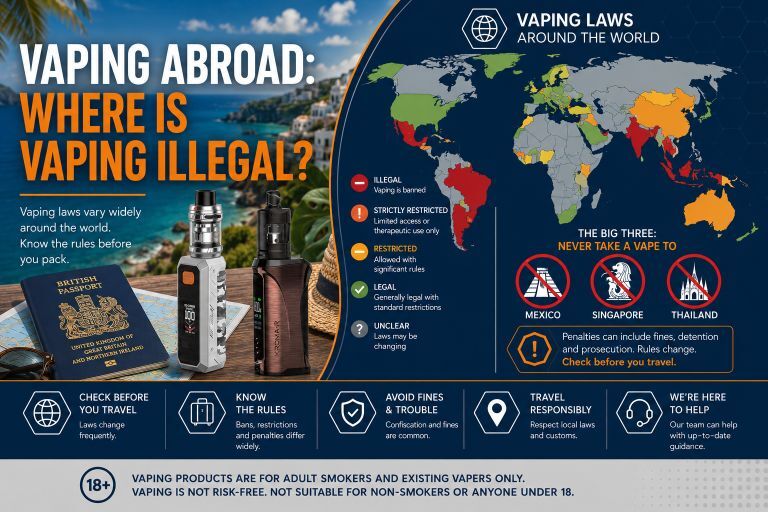
Vaping is completely legal for personal use in most of the world, including the UK, most of Europe, the USA and Australia. But a growing list of countries treat it as a serious offence, not just a no-smoking rule, and three in particular catch UK travellers out more than any others: Thailand, Singapore and Mexico. Here's what's actually banned, what's just restricted, and what to check before you pack.
Our Customer Service team fields more questions about this than almost anything else, and the same five destinations come up again and again: Spain, France, Greece, the USA and Mexico. Usually it's someone who's already booked and just wants to know whether they need to leave the vape at home.
The Three Countries to Never Take a Vape To
 Thailand has banned vaping outright since 2014, and the rules apply to everything: devices, disposables, e-liquid, all of it, nicotine-free included.
This isn't a grey area enforced loosely either. Thai police ran a month-long crackdown in early 2025 that seized close to half a million vaping items, and GOV.UK's Thailand travel advice confirms possessing or using any vape, pod or e-liquid there is illegal, with “no exceptions for tourists or for personal use.”
Offences can mean confiscation, fines typically between 5,000 and 30,000 Thai baht, detention, and court proceedings, and you may be required to stay in Thailand until your case is finalised. So the honest advice is simple: don't bring a vape to Thailand at all.
 Singapore is just as strict, and it catches people out because people assume personal use or a quick transit won't count. It does. GOV.UK's Singapore travel advice states plainly that vapes are banned, and bringing one in for personal use is illegal: anyone found with one has it confiscated and can be fined.
Penalties have been rising sharply since 2025, with further increases due in 2026, and repeat offenders risk being barred from re-entering the country.
If your case goes to investigation, GOV.UK also notes you may not be allowed to leave Singapore until it's closed, with no fixed timeline. Don't assume being in transit protects you either; airport security in Singapore is thorough, and a vape found in checked luggage has caught out plenty of travellers who never technically left the airport.
 Mexico made vaping illegal at a constitutional level, one of the only countries in the world to do this. The nuance here matters: using a vape privately isn't itself the crime, but bringing one across the border is treated as illegal importation. GOV.UK's Mexico travel advice confirms border officials will seize any device found on you, with a fine or detention both possible outcomes.
Vaping in public on top of that carries its own separate fine of up to 3,000 Mexican pesos, around £150. Carrying more than one device risks being read as an attempt to sell or distribute, which is a far more serious charge.
If you're heading to any of these three, leave the vape at home and pack nicotine pouches, gum or patches instead.
Which Other Countries Ban Vaping Outright?
Beyond the big three, a fairly long list of countries also ban vaping outright, and it's grown since older travel guides were written: Hong Kong now bans possession in any public place as of April 2026, on top of its existing import and sale ban. Vietnam banned everything from January 2025. India, Qatar, Taiwan, Brunei, Cambodia and several South American countries, including Argentina, Brazil and Uruguay, all prohibit vaping in one form or another too, with penalties ranging from a fine and confiscation up to genuinely serious jail time for anyone caught importing or selling rather than just carrying a personal device.
Two corrections worth flagging if you've read older guides on this: the UAE has not banned vaping since 2019, and Egypt lifted its ban back in 2022. Both used to be on “banned” lists that never got updated. We cover where they actually stand below.
Countries Where Vaping Is Legal but Restricted
Some destinations don't ban vaping outright, but the restrictions are significant enough to catch you out if you assume UK rules apply.
Australia only allows vaping as a therapeutic product now. Since October 2024, adults can buy nicotine vapes from a pharmacy after a consultation, but recreational high-street sales don't exist, and all disposable vapes are banned imports regardless of nicotine content. Tourists can bring a personal supply under a traveller's exemption, but it has to be declared, and you can't have more posted to you while you're there.
Turkey takes the opposite approach: using a vape is fine, but you can't buy or import one commercially, so there are no legal vape shops. There's a personal-use exemption that lets you bring in one device and up to 30ml of e-liquid (or up to ten disposables), which is generous enough for most trips, but bring everything you'll need because you can't legally restock there.
Japan is similarly split. Vaping devices and nicotine-free e-liquid are sold openly, but nicotine e-liquid itself can't be sold anywhere in the country, it's classed as a pharmaceutical. You can bring in roughly a month's personal supply of nicotine liquid without a permit, but don't expect to top up locally.
The USA is legal but a genuine patchwork. Several states, including California, Massachusetts and New York, restrict flavours to tobacco or menthol only, and California is banning disposables from January 2026. Bringing your own device for personal use is fine everywhere; buying your usual flavours may not be, depending on the state.
Europe has moved on considerably from older guides too. Finland, Denmark, the Netherlands, Hungary and the Baltic states now restrict e-liquid to tobacco flavour only. Belgium and France have both banned disposables, and the UK banned them here at home in June 2025. Poland, the Czech Republic, Greece and Spain remain genuinely vape-friendly with none of these restrictions, so the old advice on those still holds.
Where Vaping Is Legal and Genuinely Straightforward
The UAE (Dubai and Abu Dhabi), Egypt, New Zealand, South Africa, Saudi Arabia and most of the rest of Europe are broadly fine for a vaper travelling with a personal device and a reasonable amount of e-liquid. The UAE and Egypt in particular are worth flagging again since both are commonly still listed as banned in older content when neither has been for years. That said, “legal” still comes with normal-sense restrictions almost everywhere: don't vape indoors, on public transport, or in government buildings, and expect a fine rather than a shrug if you do.
One warning that applies everywhere in this section and beyond: THC, CBD or cannabis vape cartridges are treated as narcotics across the Gulf and most of Southeast Asia, regardless of how relaxed the rules are on nicotine vaping. Never bring these, whatever the destination.
What Happens If Your Vape Gets Confiscated?
In most ban countries, the realistic outcome is that your device gets taken permanently and you pay a fine there and then, rather than anything more serious. That's the pattern across Thailand, Singapore, Mexico and Hong Kong specifically.
Detention and prosecution are real risks, particularly in Thailand during enforcement crackdowns or if you're carrying enough devices to look like you're planning to sell them, but they're not the default outcome for a single personal vape. If it happens to you, the advice from every official source is the same: don't argue, don't offer money, and cooperate. Trying to talk your way out of it abroad tends to make things worse, not better.
Bringing a Vape Back Into the UK
There's no issue bringing your own vape and e-liquid back into the UK for personal use, including buying a replacement abroad if yours was confiscated. Disposables can't be sold here since the June 2025 ban, but that's a restriction on UK retailers, not on what you're allowed to bring home.
From October 2026, the new Vaping Products Duty adds a small charge to e-liquid sold in the UK, but it's aimed at the supply chain, not travellers, and a normal personal quantity brought back from a trip isn't going to be treated as a commercial import. Our guide to UK vaping laws and regulations covers the domestic picture in full if you want the detail.
Frequently Asked Questions
Do these bans apply to zero-nicotine e-liquid too?
In most of the strictest countries, yes. Thailand, Singapore and Vietnam don't distinguish between nicotine and nicotine-free products. If a country bans vaping, assume that includes nicotine-free e-liquid unless you've specifically confirmed otherwise.
Can I use nicotine pouches instead in countries where vaping is banned?
Often, yes, though check the specific country rather than assuming. Nicotine pouches aren't covered by Thailand's vaping ban, for example, which makes them a reasonable alternative for managing cravings somewhere you can't bring a vape at all.
Is it worth risking it if I'm only carrying one device for personal use?
No. Even where personal possession is treated more leniently than commercial import, you're still relying on an individual official's discretion in an unfamiliar legal system. The realistic best case is losing your device and paying a fine; the worst case in a handful of countries is genuinely serious.
Do these rules change often enough that I should check again closer to my trip?
Yes, and this is one of the fastest-moving areas of travel law right now. Malaysia is expected to move toward a nationwide ban during 2026, for example. Always check GOV.UK's foreign travel advice for your specific destination in the weeks before you fly rather than relying on any guide, including this one, as the final word.
About the Author
 Joe Delaney looks after the day to day running of V2 Cigs UK and writes its blogs.
When the blog recommends a device, he has used it - and for a leak test that means actually filling kits and trying to make them fail, pocket-carrying them and leaving them upside down overnight, rather than repeating manufacturer claims.
Health, safety and regulatory points are checked against named UK authorities such as the NHS and MHRA, and a product is only ever called "less harmful than smoking" where a UK authority says so. More about how he works, and the family story behind V2, is on Joe's author profile.
Useful Links Related to this Topic
- Understanding UK Vaping Laws and Regulations
- Nicotine Pouches - Everything You Need to Know
- Common Vaping Questions - The FAQ Hub
- Vaping Product Duty - What it Means, Costs and How to Prepare
Sources
- GOV.UK - Thailand Travel Advice
- GOV.UK - Singapore Travel Advice
- GOV.UK - Mexico Travel Advice
- GOV.UK - Foreign Travel Advice
- HMRC / GOV.UK - Published Guidance on Vaping Product Duty
- Questions and answers sourced from the V2 UK customer service and logistics teams
Vaping products are for adult smokers and existing vapers only. Vaping is not risk-free. Not suitable for non-smokers or anyone under 18.
Last updated: 21st August 2026.