
By Joe Delaney; Director and Content Writer, V2 Cigs UK
Originally Published: 13th August 2026.
Last updated: 8th September 2026.
Vaping products are for adult smokers and existing vapers only. Vaping is not risk-free. Not suitable for non-smokers or anyone under 18.
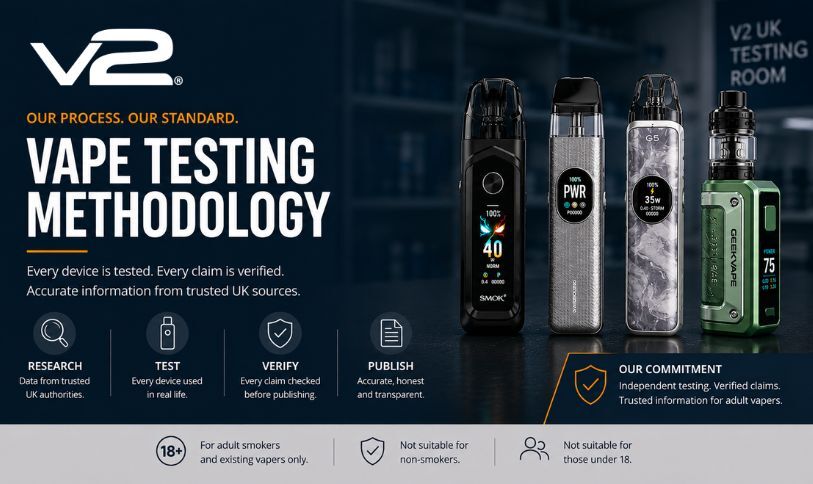
We only publish what we've actually tested, we name a drawback in every review, and if something failed, that's in the write-up too. This page sets out the standard every test on this site is held to, so you know exactly what's behind a claim before you rely on it.
This is Testing Standard v1.0, live from August 2026. If we tighten or extend it, that becomes v1.1 and onward rather than a silent edit to what's already here, so a review always reflects the standard that was actually in place when it was tested.
Our Testing Ethos
Ten principles hold for every test we run, whatever the product, whoever is testing:
- We only claim what we tested. Untested means unstated, never inferred from a spec sheet just because it sounds plausible.
- Real use beats bench numbers. We run things the way a customer actually would, for long enough that the result means something.
- The same measurements get taken every time for a given product type, so our reviews are actually comparable to each other rather than each one inventing its own criteria.
- Conditions are always disclosed: what liquid, what strength, what device, how long, and who tested it.
- Every review names at least one drawback. A review with no downside is an advert, not a review.
- Failures get published. If something leaked, died, or arrived faulty, that's the most useful sentence in the piece, not the one we quietly drop.
- Whoever runs the test writes the review, or is named in it as the tester. The standard is held by this document, not by any one person, so anyone following it produces a review to the same standard.
- Health, safety and legal claims never come from our own testing. They come from the NHS, MHRA, OHID or gov.uk, and they're cited. Testing tells you how something performs. It doesn't tell you whether it's safe, and we don't pretend otherwise.
- Our own products are tested to exactly the same standard, and their drawbacks are published the same way. We don't benchmark our own brand against named competitors.
- AI tools help us draft articles and screen drafts against our CAP/ASA checklist. No AI decides what we publish: every performance claim comes from a test we actually ran, every health or legal statement is checked against a named source by a person, and a named person approves each article before it goes live.
How Thoroughly We Test, and How We Label It
Not every product gets the same depth of testing, and we label honestly which one it got rather than implying more than actually happened.
A Quick Look covers a few days of use and the core record only: first impressions, no long-term claims. A Full Test runs a week or more and adds the full set of measurements relevant to that product type on top of the core record. A Long-Term Update is a revisit two to three months later, appended to the original review with a new date, catching anything that only shows up over time.
What We Actually Record
Every test, regardless of depth, captures the same core information: what the product is, our tester, where it was used, the exact dates and how many days that covers, what it was paired with, one thing that stood out and one thing that didn't work, who the product actually suits, and anything that failed or broke, stated plainly if nothing did. We also keep our own photos and a short passage in the tester's own words, so a review is never just a features list dressed up as an opinion.
Every review is one unit tested, not a manufacturing sample. If your own device behaves differently from what we describe, that's a real possibility with any single product, not a sign the review was wrong.
Every photo in a review is one we took ourselves during testing, never a manufacturer's product render presented as our own. We don't use star ratings either. Our edge is the measurements, not an opinion score, so where other sites publish a number out of five, we publish what we actually measured instead.
For products that get a Full Test, we take the same additional measurements every time for that product category, whether that's battery and charge behaviour for a device, flavour accuracy and coil-life for an e-liquid, or puff-count honesty for a disposable. Testing the same things the same way every time is what makes our reviews comparable to each other rather than a one-off impression.
For a Full Test, the extra measurements depend on the product, and they're the same every time for that category.
For a device: weight, charge time from flat to full, battery life measured off the charger to cut-off with the puff counter noted at both ends, which mode it shipped in, the airflow or wattage setting that worked best, and an overnight leak test.
For an e-liquid: how the flavour compares to its name, throat hit at the stated strength, whether the flavour holds across a full tank, and how much liquid goes through a coil before it mutes.
For pods and coils: how much liquid passes before flavour drops off, how many refills a pod takes before it needs replacing, and any seepage at the contacts.
For a big puff or prefilled device: the claimed puff count against the number we actually counted, and how the flavour holds at a quarter, half, three quarters and the end.
Numbers from a single unit aren't laboratory figures and we don't present them as though they are. They're what happened when one person used one product under stated conditions, which is exactly what a spec sheet can't tell you. In all of our posts that contain tests, we will go over what we tested and how we did it in more detail, but the tests are almost always the same, and when they change, we only add more tests to help better inform our readers.
What Stays the Same Every Time
We test on our own e-liquid range rather than a competitor's. That means Platinum, 100% VG or Gourmet, so the flavour language in one review means the same thing in the next, and we're testing on stock we actually sell.
We use two nicotine strengths and we always say which. Endurance work - battery life, pod life, leak testing - runs at 0mg, because nicotine has no bearing on how long a battery lasts or whether a pod seeps overnight. Throat hit and satisfaction get assessed separately at (12mg). Where a test used both, the review says which was used for which part.
What does change is the type of liquid, and that's deliberate. A 50/50 or a nic salt goes in an MTL pod kit; a high-VG shortfill or our 100% VG goes in a sub-ohm tank. Putting the wrong liquid in a device doesn't test the device, it tests our carelessness. The review always names what was in it.
Beyond the liquid: every device test starts from a full charge with the arrival charge noted, leak tests run overnight at room temperature with a full pod and the fill port down, and cold-weather testing is always its own test rather than something bolted onto another one.
We Tell You What We Don't Test
Every review carries a short statement of what was and wasn't covered, near the top or directly under the verdict. Saying plainly what we didn't test is one of the more unusual things a vape review site can publish, and it's honest: a seven-day test can tell you a great deal, but not everything, and we'd rather say so than imply otherwise.
How We Check Compliance
This is an overview of a wider process: we check every claim against the bodies that actually regulate or set standards for this industry, so nothing goes live that we can't stand behind.
Every health, safety, legal or statistical claim carries a named UK source at the point it's made: the NHS, MHRA, OHID, RCP, ASH or GOV.UK. Regulatory status is checked live before publishing, never written from memory, which matters more than usual right now with the Tobacco and Vapes Bill and the Vaping Products Duty both moving.
Drafts are screened against CAP/ASA rules before going live: no "safe," no cessation or medicinal claims, comparative-harm statements only where they're attributed to the NHS or RCP, and nothing that could appeal to under-18s.
Every product we sell and every device we review is checked against the UK's Tobacco and Related Products Regulations, the domestic implementation of the EU's Tobacco Products Directive that sets the baseline safety and notification standard for anything sold here.
We also track guidance from the UK Vaping Industry Association, the sector's trade body, whose code of conduct on age-aware retailing and marketing informs how we operate day to day. UKVIA isn't a regulator and its guidance doesn't carry legal force the way MHRA or TRPR do, but aligning with it is part of how we hold ourselves to a higher bar than the legal minimum.
An adult-only notice sits at the top and bottom of every post, and a named person signs off before anything publishes. Right now that's Joe.
Frequently Asked Questions
What's the difference between a Quick Look and a Full Test? A Quick Look is a few days of hands-on use and covers first impressions only, with no long-term claims. A Full Test runs a week or more and adds the full set of measurements for that product type. Both are labelled clearly on the review itself.
Do you say what you didn't test? Yes, in every review. We think it's one of the most useful parts of the page, since it tells you exactly how far you can trust the verdict rather than leaving you to guess.
What e-liquid do you test with? Our own range, so that the flavour language in one review means the same thing in the next. Endurance testing - battery life, pod life and leak testing - runs at 0mg, because nicotine has no bearing on how long a battery lasts or whether a pod seeps overnight. Throat hit is assessed separately at 12mg unless stated otherwise. The type of liquid is matched to the hardware, so a 50/50 or nic salt goes in an MTL pod kit and a high-VG liquid goes in a sub-ohm tank. Every review names exactly what was in it.
Where do your health and safety claims come from? Named UK authorities only: the NHS, MHRA, OHID, RCP, ASH or gov.uk, cited at the point each claim is made. We never write a health claim from memory, and we never say vaping is "safe."
Do you review products you sell? Yes, and that's worth being upfront about. Everything we review is stock we sell, so we test our own brand to exactly the same standard as everything else and publish any drawbacks the same way. We don't take payment from manufacturers for reviews, and we don't benchmark our own products against named competitors. If a product we sell performed badly in testing, that goes in the review.
Do you give star ratings? No. We publish the actual measurements instead of a score out of five, because a number invites the kind of rounding and inflation that a stated measurement doesn't.
Who signs off before something is published? Joe Delaney signs off every review and guide against this standard before it goes live.
Does Joe write all the posts? No. Not all of them, if a different author is behind the post then they will be listed as the author and will have their own author page - unless they are a guest author.
About the Author
 Joe Delaney is the Director and Content Writer of V2 Cigs UK, a family-run vaping business that started in 2012, he manages the blog and writes the majority of the blog posts.
When the blog recommends a device, he has used it - and for a leak test that means actually filling kits and trying to make them fail, pocket-carrying them and leaving them upside down overnight, rather than repeating manufacturer claims.
Health, safety and regulatory points are checked against named UK authorities such as the NHS and MHRA, and a product is only ever called "less harmful than smoking" where a UK authority says so. More about how he works, and the family story behind V2, is on Joe's author profile.
Sources
GOV.UK - E-cigarettes: regulations for consumer products
UK Vaping Industry Association - About UKVIA
Vaping products are for adult smokers and existing vapers only. Vaping is not risk-free. Not suitable for non-smokers or anyone under 18.
Last updated: 8th September 2026.
Testing Standard v1.0 - August 2026